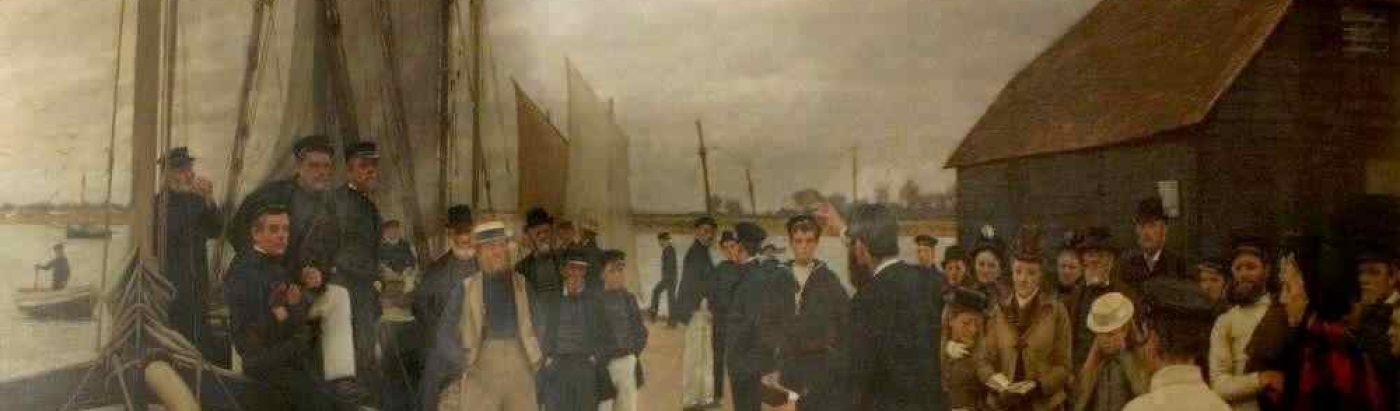

Visiting the State Library of New South Wales (SLNSW) in December 2025, I have been tracking the ups and downs of the Sydney Bethel Union, Mariners’ Church and Rawson Institute for Seamen, conducted by the NSW Missions to Seamen. The SLNSW holds the archives of the latter and they provide a window into the history of the port of Sydney and its rumbunctious sailor town and community.
Today, the former Mariners’ Church is hidden behind the facade of the Rawson Seamen’s Institute (named for the governor), and is currently serving as a pub – following extensive restoration.

From the 1820s, there were multiple spasms of enthusiasm for a dedicated, non-denominational mission for the physical and moral welfare of Sydney sailors, but efforts were dogged by debt, sectarian rivalries for control, and the arrival and departure of seamen’s chaplains of various denominations. The latter included a number of Presbyterians, enticed to the port by the promises of the Rev. John Dunmore Lang. My eye was caught by the first salaried chaplain of the Sydney Bethel Union, the Rev. M.T. Adam, who served from 1841 to 1845. Lang had gatthered Adam through his American connections, and his appointment came with letters of introduction from the American Seamen’s Friend Society. When he raised the Bethel Flag on 18 February 1841, it was seen as the beginning of a new era for the troubled mission (The Australian, 2 April 1842, p.3). Adam was a learned preacher who was included, with Lang, in a series of lectures on Sabbatarianism (Lang, 1842). He was also a committed temperance advocate.
Unfortunately, Sydney could not hold him – possibly because of a perennial inability to pay the seamen’s chaplain a proper salary. In 1845, Adam made a dignified retreat to America, leaving behind his extensive library of theological books which he was, presumably reluctantly, forced to sell to finance the return trip.
Yet Adam, or someone with Adam’s religious and personal resources, was urgently needed. On the same page of The Sentinel (5 Nov. 1845) which reported on Adam’s departure from the colony, there was an account of a riot by seamen of HMS Fly, the police and assorted English and French sailors on shore leave in and around George Street. This involved hundreds of people and included an attack with a sledgehammer on the police lock up, resulting in the release of two prisoners. In the aftermath, the police could do little more than refer the offenders to their respective captains and speed the on their way.
There were echoes of the celebrated riot by sailors in October 1841, when a sailors from HMS Favourite stormed the St James watch house in order to release one of their colleagues. Police fired on the rioters, leading to the accidental shooting of Claude Burrows, a shoemaker, who died some weeks later. The Coroner’s inquest absolved the police from any wrong doing (The Sydney Gazette, 23 Oct 1841, p.2). Despite the violence, no action was taken against the police.
Ten years later, on 23 August 1851, there was another violent encounter between Sydney’s visiting sailors and police during the attempted arrest of a cross-dressing comrade. Armed with clubs and iron palings, sailors from the Caliope and Pandora aided their escape from the watch-house to the cheers of the crowd watching from the nearby pubs. (libcom.org)

Following Adam’s departure, the role of seamen’s chaplain was assumed by the venerable missionary to the Aborigines, the Rev. Lancelot Threlkeld. While his integrity was never questioned, his stern outlook was unlikely to draw many of the sailors, rioting or otherwise, to the mission. Nevertheless, it was under Threlkeld that the splendid Mariners’ Church on the site of 100 George Street was finally erected.
With some trepdiation, the dedication of the corner stone for a new, and ambitious, Mariners’ church was laid by Governor-General Denison in March 1856 (Empire, 20 March 1856). Denison’s corner stone is now held by the Sydney Maritime Museum.

The church itself finally opened on 27 Febuary 1859, but continued to struggle financially. In 1895, the Sydney Bethel Union agreed to lease it to the Anglican Missions to Seamen for a nominal £1 annual rent, while retaining some financial control through a trust. The first chaplain under the new management was the Rev. T.H. Distin Morgan, who served as chaplain from 1895 to 1905. Under MTS auspices, the Mariners Church – and its successor institution the Rawson Institute – would serve the maritime community of Sydney for over hundred years.
In 1971, the Mission to Seamen relocated to Macquarie Place by which time Sydney’s commercial shipping had long since ceased to enter Sydney Cove. However, the cluster of buildings in The Rocks, including the Rawson Institute, the former Sailor’s Home nearby, along with Royal Naval House, known as ‘Johnnies’ at 32-34 Grosvenor Street, are a reminder of Sydney’s salty, occasionally riotous, past, and the efforts of moral guardians such as the Bethel Union and the Missions to Seamen to civilise and Christianise the port.
References
MLMSS 9082. Missions to Seamen NSW Archives. SLNSW
Empire, 1856
Lang, John Dunmore, M.T. Adam, William McIntyre, James Fullerton, and John Tatt. 1841. Lectures on the Sabbath: occasioned by a recent discussion in the Legislative Council of New South Wales; and delivered in the Scots Church, Sydney, on Sabbath, July 18th 1841, and the four following Sabbaths, by ministers of the Presbyterian Church. (pr. James Reading: Sydney).
The Sentinel (Sydney), 1845
Sydney Gazette, 1841
Sydney Bethel Union. 1894. Seventy-First Report of the Sydney Bethel Union, from December 31st 1892 to December 31st 1983 (pr. William Brooks: Sydney).